Van den Berg

- Service
- E-commerce architecture and integration
One catalogue. Several destinations. Two ways to sell, to consumers and professionals.
Working with Van den Berg, Not a Monkey connected business management to online sales. A product manager enriches ERP data with Icecat, preserves the team’s corrections and feeds several destinations, including a PrestaShop multistore installation for DirectElectro in B2C and Vandenberg in B2B.
Context
Van den Berg sells household appliances and electronics to two audiences: consumers on directelectro.be and professionals on vandenberg.be. Catalogue and stock are shared, but access to prices, commercial terms and ordering journeys follow different rules.
The information needed for selling is spread across several sources. The TIP / Integral ERP holds references, prices, stock and web publication authorisation. Icecat provides manufacturer content, specifications and available media; EPREL adds energy information. The team needs to correct a product page without losing its work at the next import.
This catalogue also feeds other systems. The challenge is therefore to define which source takes precedence, preserve useful corrections and produce the data each destination expects, while making blockers understandable to the people managing products every day.
From source data to the ordering journey
Connecting ERP and catalogue with Integral
Retrieving ERP changes, storing data locally and enriching it with Icecat / EPREL. References connect products across systems. Prices and stock remain controlled by the ERP; content, media and specifications can be completed in the product manager.
Giving the team control over product pages
Creating a search and correction interface: source and selected values, FR/NL text, field-by-field overrides, image order, exclusions and document uploads. Corrections are stored separately from imports, with a history for tracing changes.
Adapting exchanges to each destination
Building the data expected by the PrestaShop API, transmitting source data to an internal Van den Berg project in a JSON envelope containing, among other elements, TIP XML, and providing a dedicated integration with a partner catalogue. Each connector follows its own rules and synchronisation statuses; success at one destination does not confirm success at the others.
Controlling catalogue publication
Distinguishing between importing, creating and activating a product. New PrestaShop pages are created inactive. ERP web authorisation, deletions, duplicate references, usable stock and supplier orders inform publication decisions. Manual activation cannot bypass an ERP refusal to publish.
Making B2C and B2B sales work together
Setting up a shared PrestaShop foundation with rules specific to each shop. DirectElectro provides the consumer journey. Vandenberg reserves prices and ordering for approved professional accounts linked to ERP pricing terms, with prices excluding VAT and deferred payment. The shop context prevents professional prices from applying to the B2C journey.
Supporting day-to-day operations
Developing modules for receiving catalogue data, energy labels, shipping rules, professional access and manageable content. Precise search by reference or EAN, availability by depot, professional catalogue export, PDF order summaries and integrated guides complete the journeys. Tests focus in particular on FR/NL languages and separation between shops.
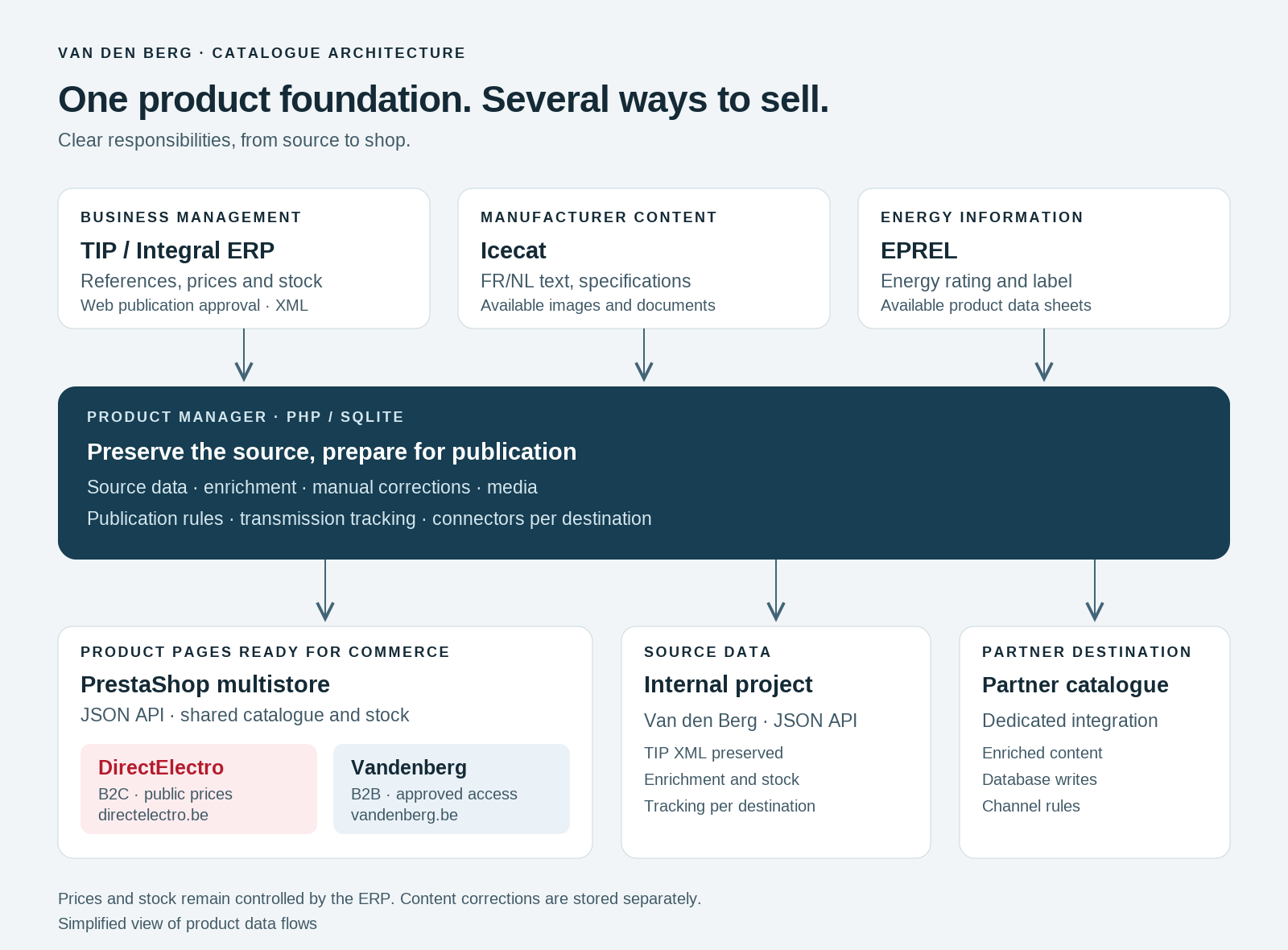
Controlled data, multiple channels
Each source has its role. Each destination receives the format it expects.
The PHP manager connects the TIP / Integral ERP to Icecat and EPREL enrichment. It preserves source data, applies corrections to commerce-facing content and prepares exchanges. PrestaShop receives product pages for its two shops; the internal Van den Berg project receives source data; a partner catalogue has a dedicated integration. Sensitive commercial information stays in the business systems.
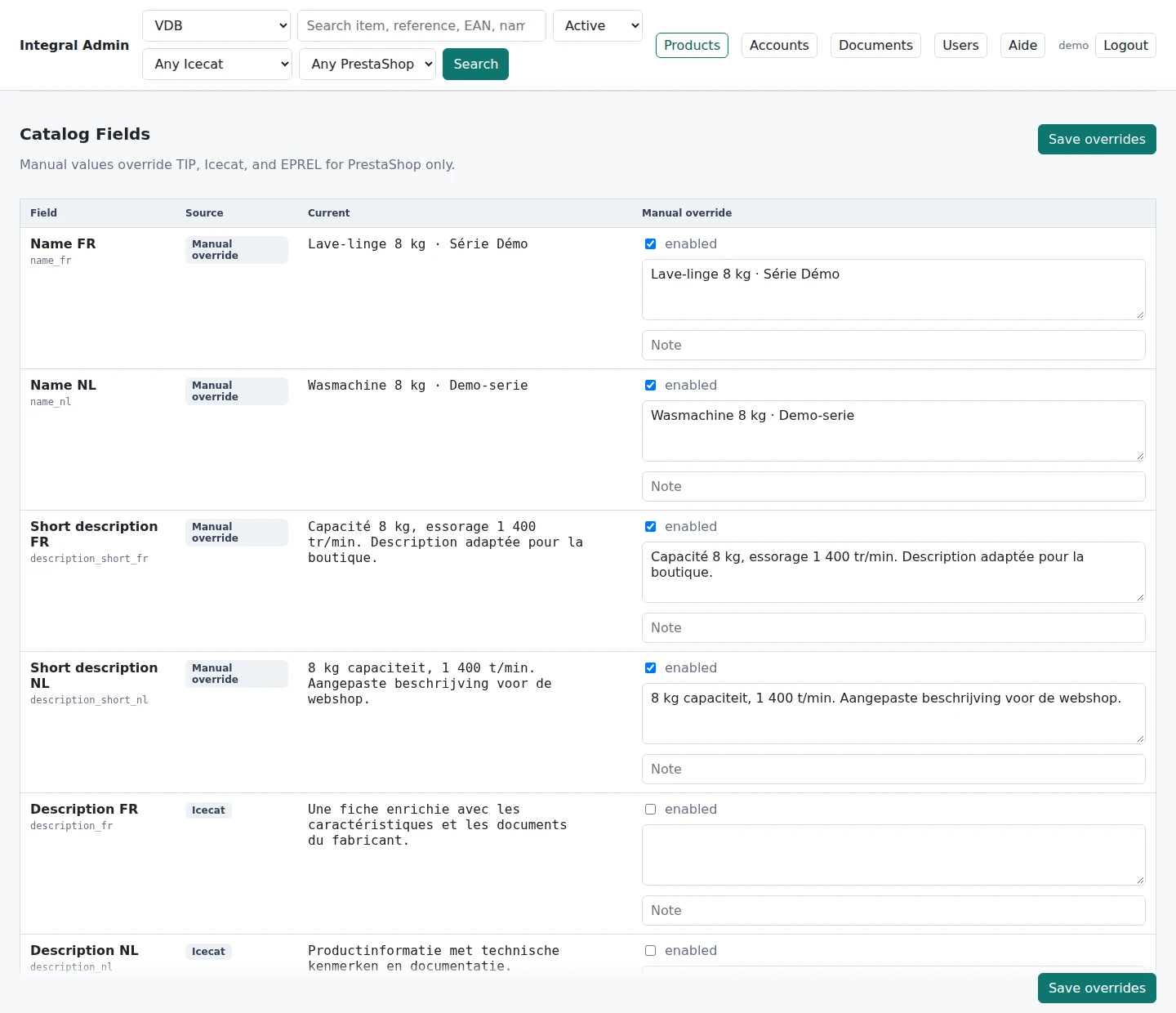
Correcting a product page without losing the source
Seeing the source, choosing the published value and preserving the correction.
The manager displays catalogue fields, their sources and active corrections. The team can adjust a title or description in French and Dutch, then return to the automatic value by disabling the correction. Prices and stock follow a different route: they are corrected in the ERP. This interface screenshot uses only a fictional demonstration product.
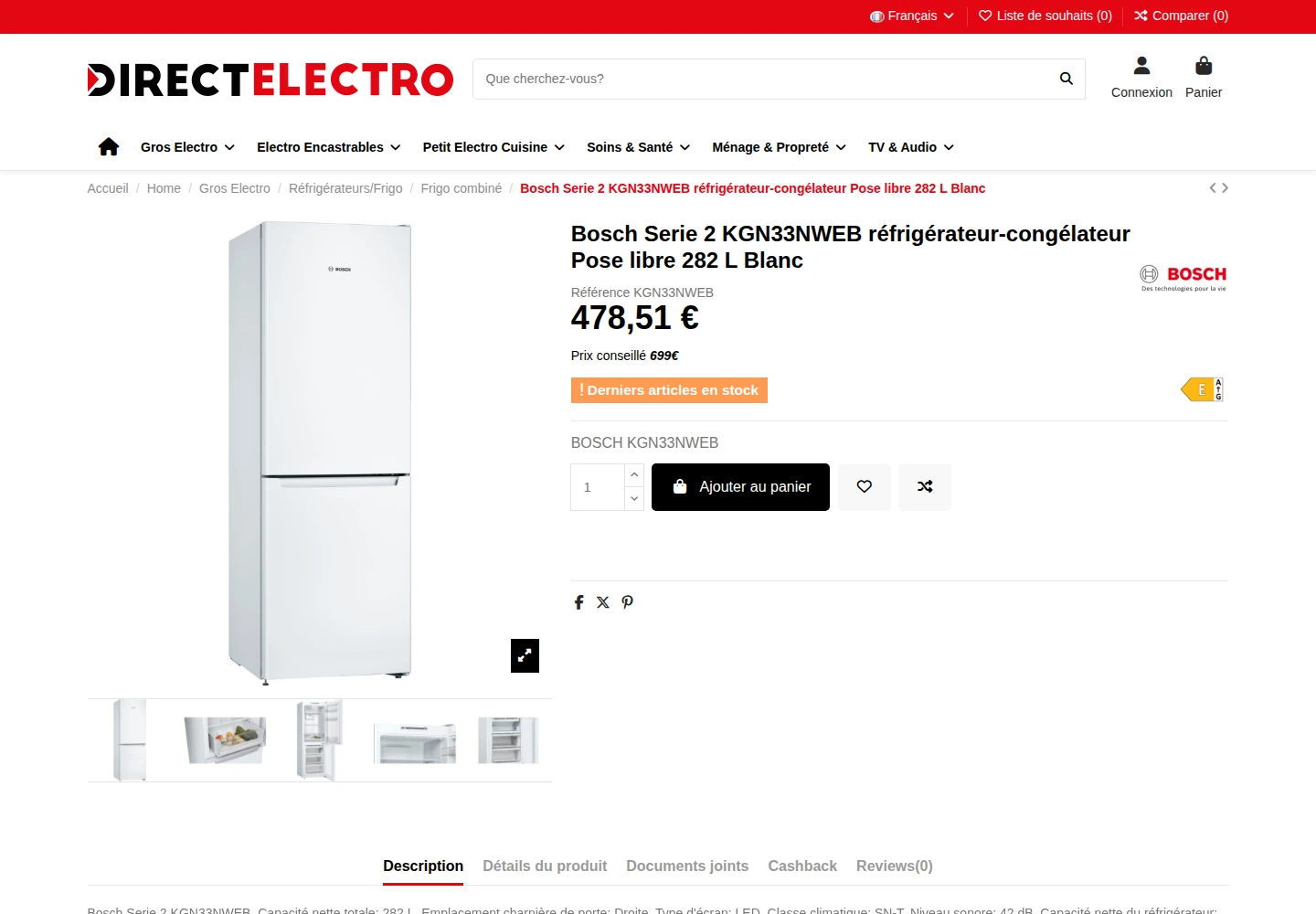
DirectElectro: a product page ready to sell
Bringing together the product, its specifications and useful buying information.
In the B2C shop directelectro.be, the data feeds a consumer product page with photos, price, availability, specifications and energy documents. Custom modules connect this information to purchasing: FR/NL labels and product sheets, collection or delivery options, and carrier selection based on area and basket contents. Screenshot of the local shop, with no account signed in.
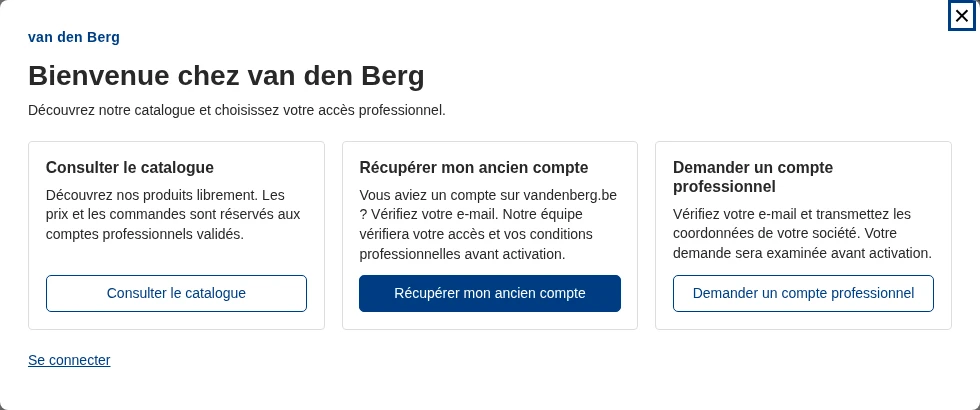
Professional access that is verified
Browsing, recovering an old account or requesting new access.
Vandenberg distinguishes browsing the catalogue from granting commercial access. Both recovering an old account and requesting a new one require email verification and team review. Matching the company in the ERP and assigning pricing remain separate from approval. Teams have request tracking and a guide in the administration. The screenshot shows only the public entry to the journey.
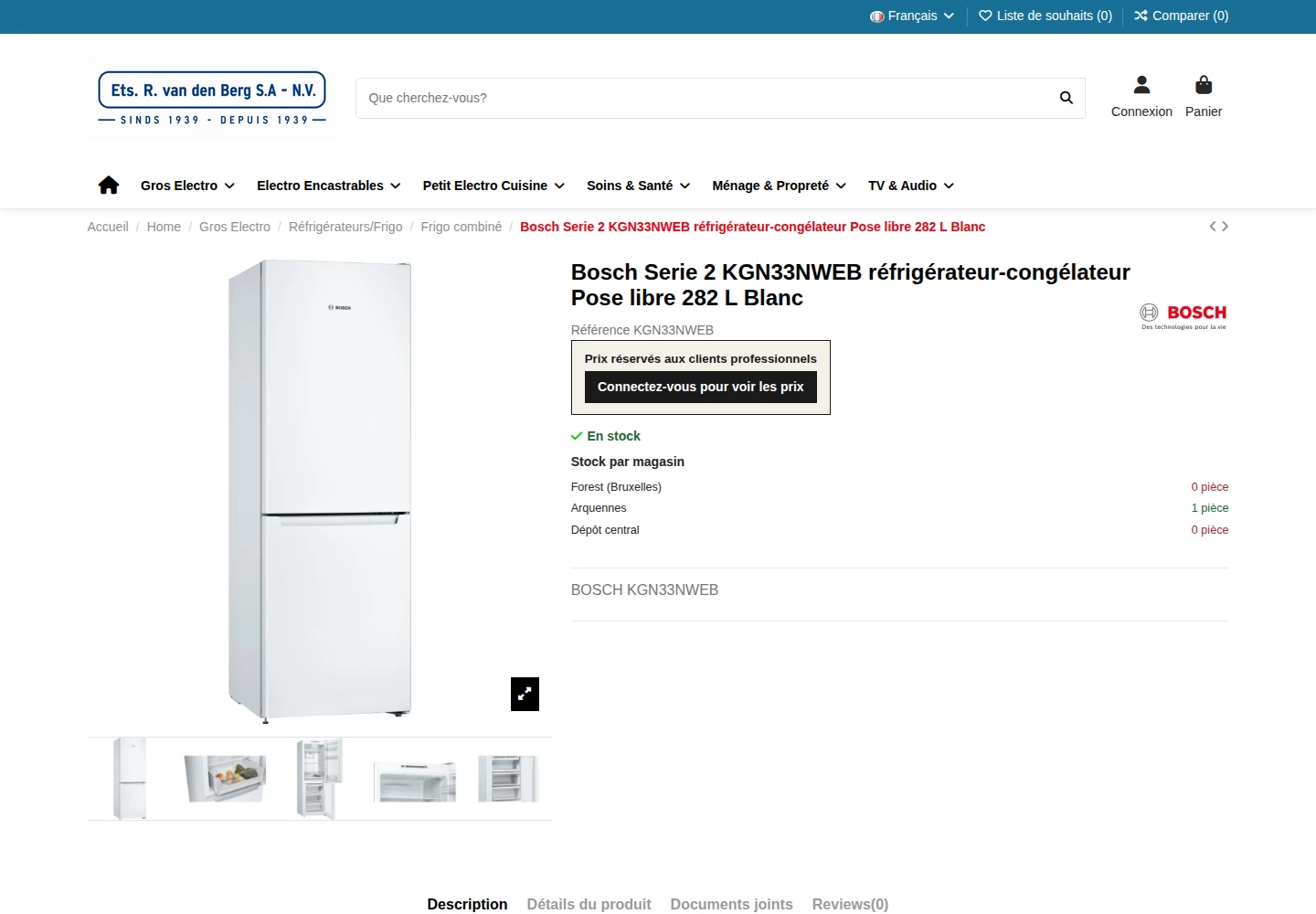
The same product, specific B2B rules
Preserving the shared catalogue while respecting the commercial relationship.
On vandenberg.be, visitors can browse products, but prices and ordering are reserved for authorised professionals. Search by reference or EAN prioritises the exact model. Once access is approved and ERP pricing linked, the journey offers prices excluding VAT, deferred payment and delivery in Belgium. Professionals also have a catalogue export and PDF order summaries. The screenshot remains in visitor mode, without private prices or personal data.
Does your catalogue connect several tools and ways of selling? Let’s structure the sources, exchanges and business rules into a coherent system.
E-commerce architecture and integration