Forcado

- Service
- Product strategy and development
Connecting orders, workshop, shops and invoicing in one business platform.
At Forcado, an order does not end at the basket: it leads to preparation in the workshop, collection or delivery, then administrative follow-up. Not a Monkey designed and developed a custom platform to connect these stages, from the professional catalogue to recurring orders and invoicing, while supporting the tool’s ongoing evolution.
Context
An artisan patisserie needs to align different rhythms: one-off orders, professional customers’ regular needs and shop replenishment. Quantities, dates, prices and receiving arrangements must stay consistent through to preparation.
The need went beyond publishing a catalogue online. It called for a shared business tool, with access adapted to each role, commercial rules specific to B2B customers and continuity between ordering, fulfilment and invoicing.
Testimonial
« Jean-Charles designed a platform with us that connects our professional orders to the work of the workshop, shops and administration. We can adapt the catalogue to our customers, manage their recurring orders and track invoicing in one tool. The platform continues to evolve with our needs. Beyond the product, the working process and the quality of the collaboration were decisive for us. I also want to highlight Jean-Charles’s responsiveness: he is always reachable, even when a request comes in at the last minute. »
Translated from French.
Our work on product strategy and development
Step 1 - Scoping business journeys
Translating the needs of customers, administration, workshop and shops into distinct journeys: ordering, planning, preparing, receiving and invoicing. Defining roles, statuses and the information to pass between each stage.
Step 2 - B2B catalogue and orders
Developing a customer area with a catalogue, price groups and product selections suited to professionals. Supporting the basket, collection or delivery arrangements and order tracking from the customer account.
Step 3 - Recurring orders and operational coordination
Implementing scheduling by product and day, with frequency, start date and approval of recurring orders. Connecting this to shop orders, their inventory and workshop preparation stages.
Step 4 - Invoicing and integrations
Structuring order grouping, PDF documents and issuing companies. Integrating Falco for invoice transmission and Peppol status tracking, with configuration specific to each company.
Step 5 - Evolution and maintenance
Evolving the Symfony foundation and Angular back office as needs develop. Adding test scenarios for business journeys and invoicing, and structuring deployment and backup procedures.
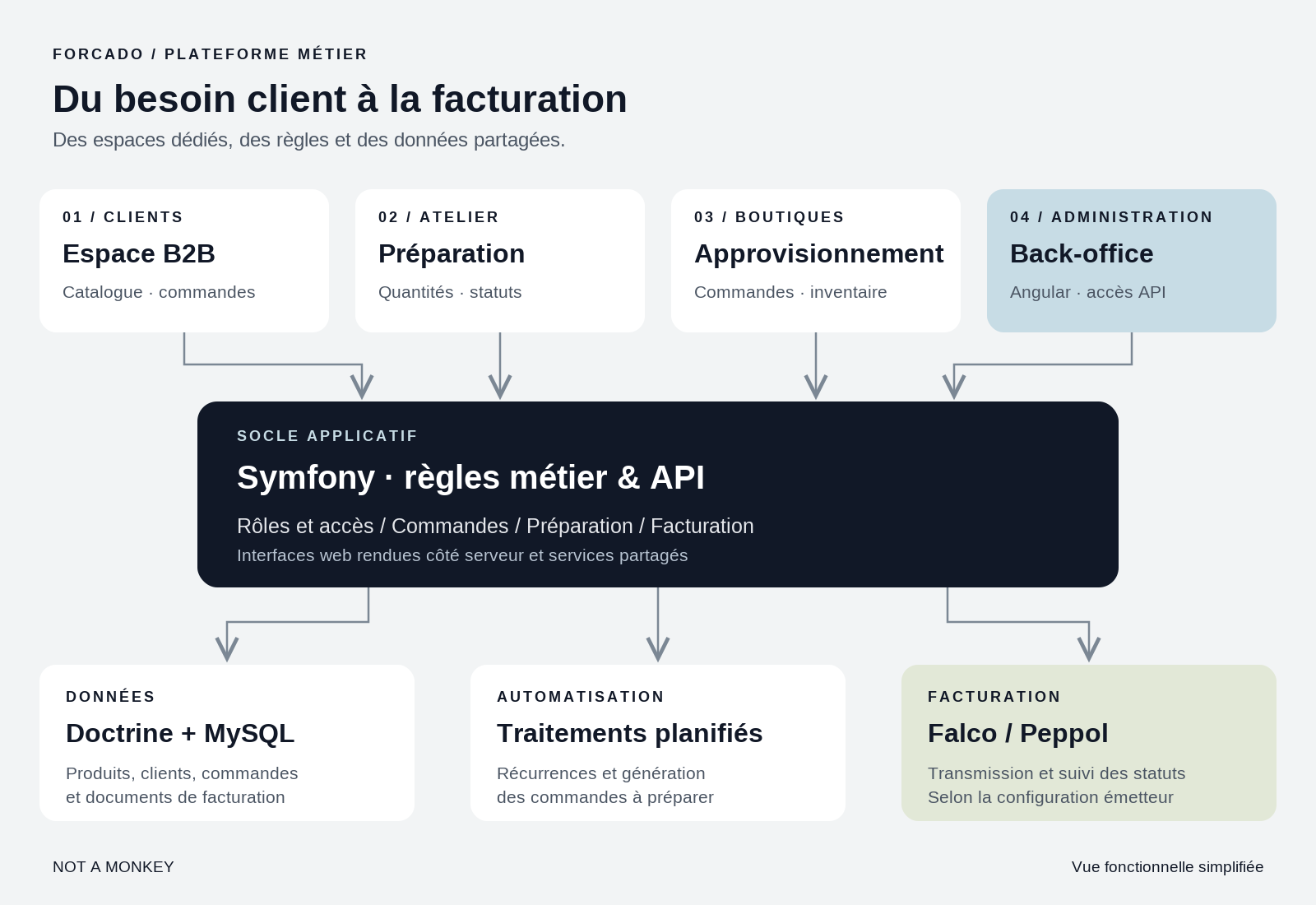
Product architecture and operations
Interfaces adapted to each role, with a shared business foundation.
Symfony handles the rules for ordering, preparation and invoicing. The customer, workshop and shop web interfaces build on this foundation, complemented by an Angular back office connected to the API. Doctrine and MySQL centralise the data. Scheduled processes handle recurring orders, while the Falco integration connects invoicing to Peppol tracking according to each issuer’s configuration.
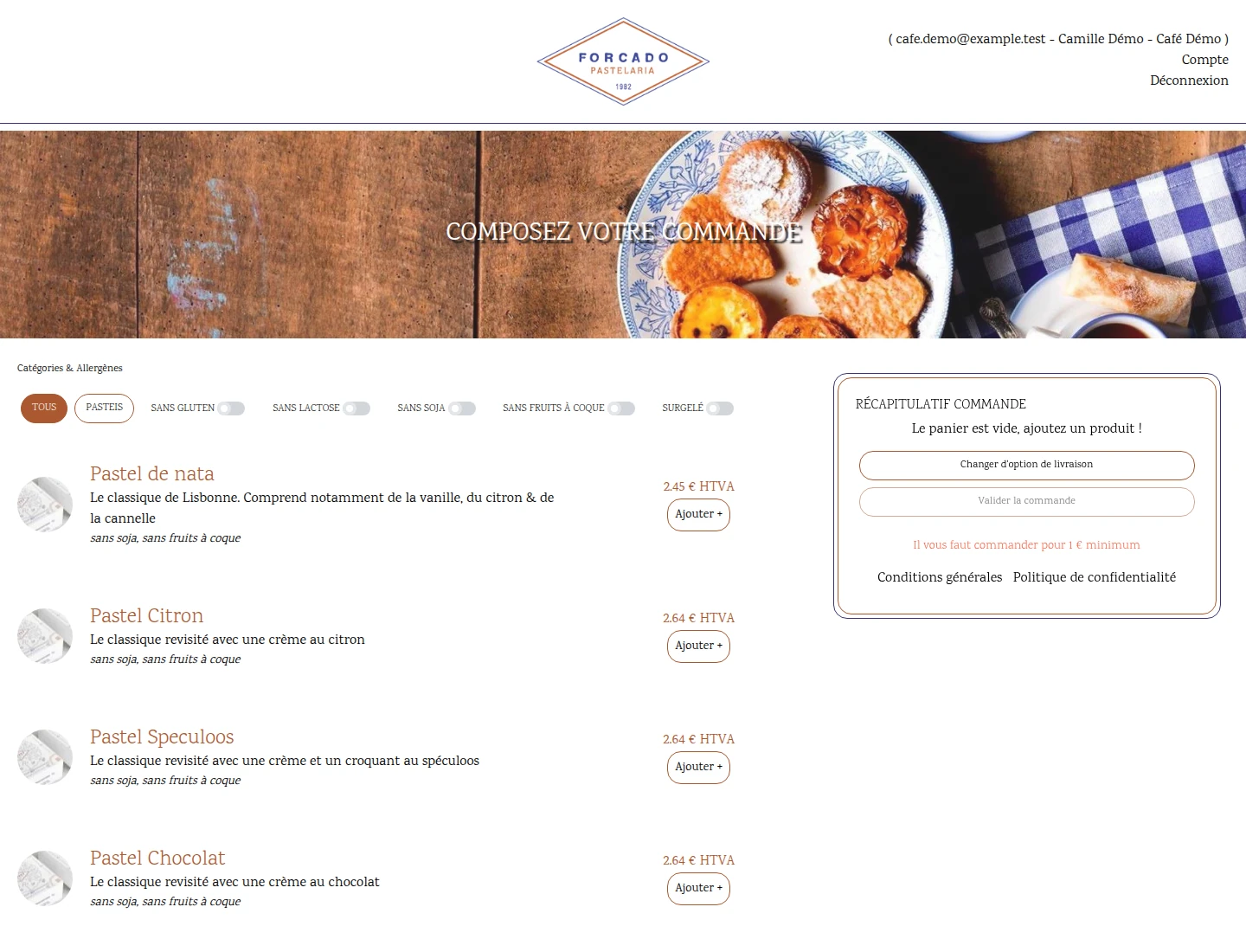
A catalogue for professionals
Ordering in a space suited to the commercial relationship.
Professional customers find the products and prices for their group, build their basket and access their account from the same interface. The catalogue can be limited to a dedicated selection to present a relevant offer to each profile. Screenshot of the application with the fictional Café Démo account and demonstration prices.
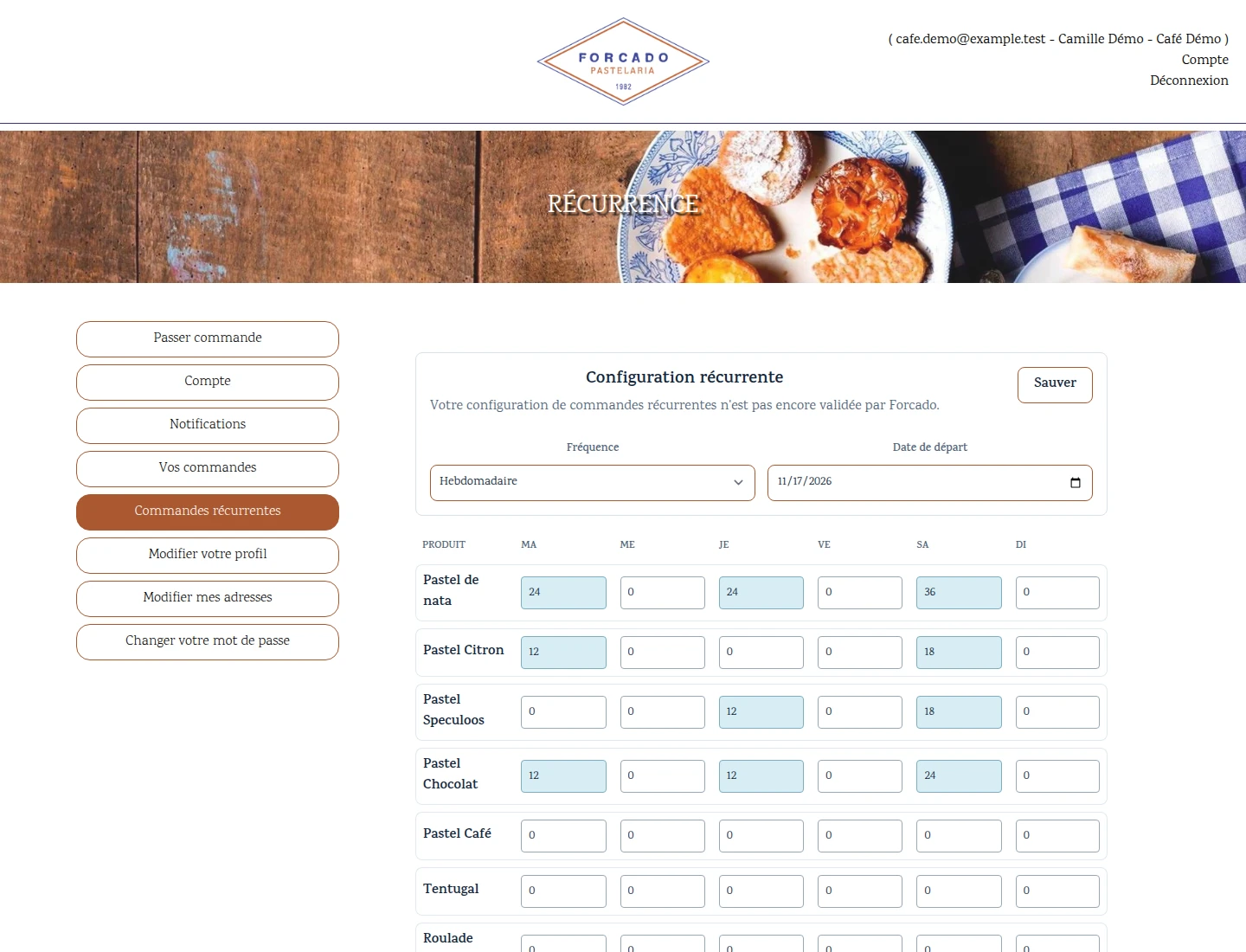
Planning regular orders
Defining the week’s needs, product by product.
The recurring schedule lets customers enter quantities by day, a frequency and a start date. An approval step distinguishes the customer’s requested configuration from its operational handling. Regular needs become structured data for preparation. Screenshot of the application with a fictional, inactive configuration.
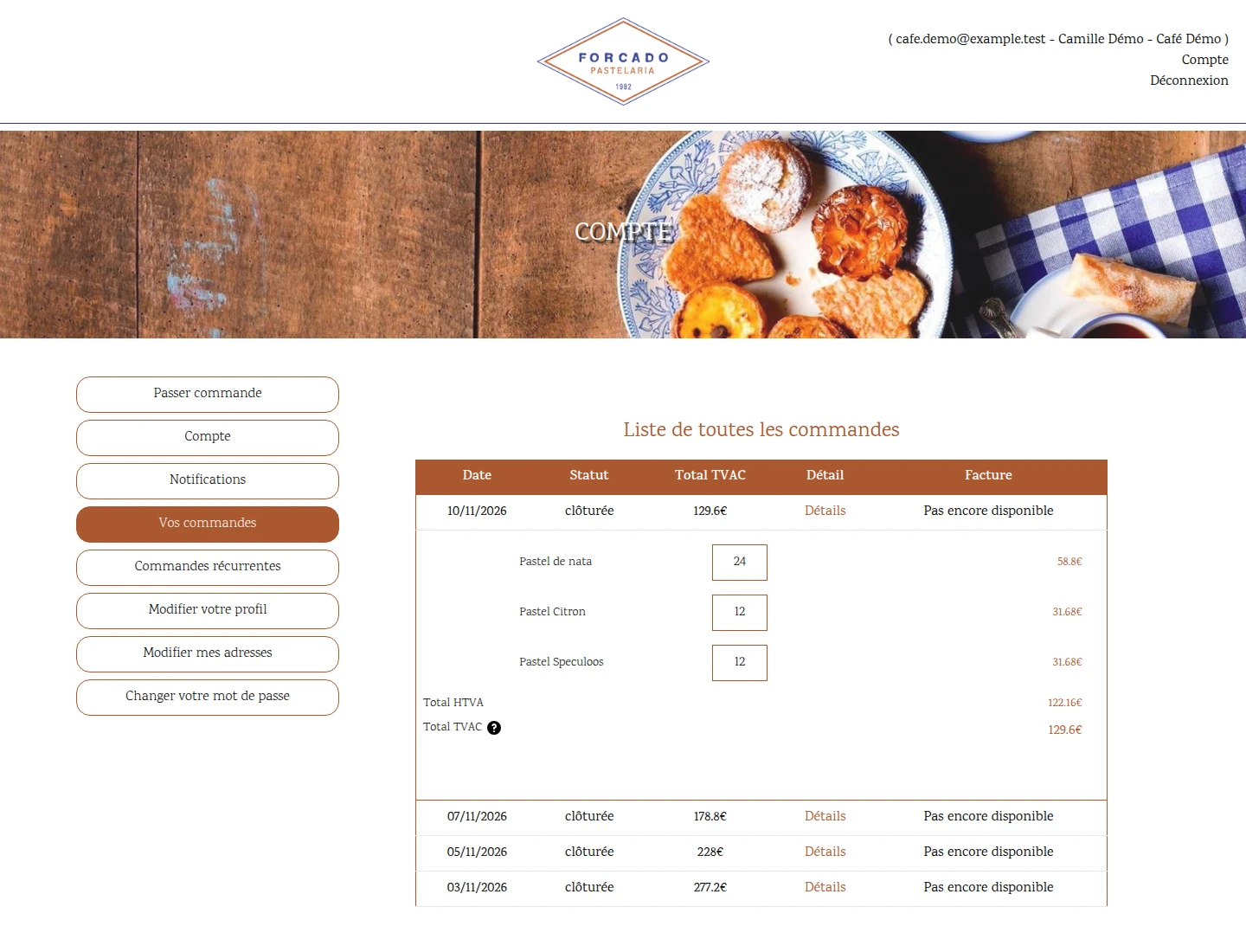
From ordering to administrative follow-up
Finding orders and understanding what was ordered.
The history brings together dates, statuses, amounts and product details. Customers can view their orders and download an invoice when available. In administration, grouping and choosing the issuing company extend this journey through to invoicing. Screenshot of the customer area with fictional orders, without issuing or transmitting any invoice.
Like Forcado, connect your orders, operations and invoicing in a business tool designed around your activity.
Product strategy and development